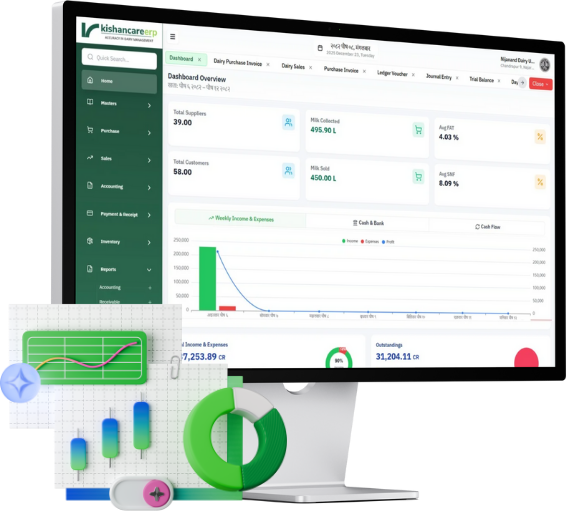


For many dairy co-operatives and milk collection centers, milk collection software Nepal is no longer just a nice-to-have tool. It is becoming a practical way to reduce queues, avoid fat/SNF pricing mistakes, improve farmer payment trust, and prepare cleaner daily reports.
Key takeaways
Why milk collection software Nepal matters
Across Nepal, milk collection still often depends on manual slips, handwritten registers, calculator-based rate entry, and delayed ledger updates. This can work when volume is small, but once a co-operative handles morning and evening shifts, multiple farmer groups, fat/SNF-based pricing, route dispatch, and payment tracking, small errors start creating serious operational pressure.
A better system is not only about digitization. It is about making daily collection faster, more accurate, and easier to verify for farmers, collection staff, accountants, and committee members.
Collection centers operate under time pressure
Farmers arrive early, staff record quantity and quality, analyzer readings need to be captured, and milk must move quickly to chilling, transport, or processing. When the process is slow, farmers wait longer, shift totals are delayed, and staff rush entries at the end of the day.
Accuracy affects farmer trust
For dairy co-operatives, collection accuracy is not just an office issue. If a farmer believes their liters, fat, SNF, deductions, or payment calculation is wrong, the co-operative must spend extra time explaining and correcting records.
The daily workflow problem in manual collection
A common manual workflow at a Nepali milk collection center starts with a farmer bringing milk to the collection point. Staff write the farmer name or code on a slip, record quantity, note fat and SNF values from the analyzer, calculate the rate manually or in Excel, and later copy the details into a register or ledger.
Each step may look simple, but every re-entry creates risk. A wrong farmer code, unclear handwriting, missing analyzer value, or duplicate line can affect the final payment. This is why dairy co-operative software Nepal should focus first on the collection workflow. If the first record is wrong, the ledger, payment, inventory, and report can all become wrong later.
An NDDB-commissioned co-operative study noted that many sampled milk producer co-operatives were still using conventional record keeping and single-entry manual bookkeeping. That reality makes practical digital collection workflows especially relevant for Nepal.
Where milk collection errors happen most often
Most collection errors are small at the point of entry but expensive by the time they reach payment and reporting. The common causes are not unusual: busy collection hours, repeated manual copying, unclear staff responsibility, and delayed reconciliation.
Wrong farmer code or member record
Many co-operatives have farmers with similar names, family members supplying under one account, or old codes still used in registers. A small code error can credit milk to the wrong supplier. Centralized farmer records help staff search and select the correct member instead of relying only on memory or handwritten notes.
Wrong quantity, shift, or analyzer value
Morning and evening collections must be separated clearly. If evening milk is entered under the morning shift, daily totals and payment summaries become confusing. Missing fat/SNF values create another problem because milk buying in Nepal is often not just liters multiplied by a flat rate.
Duplicate or delayed entry
When staff first write on slips and later enter into a ledger or spreadsheet, duplicate records become common. Delayed entry also makes it harder to remember corrections, rejected milk, or special remarks from the collection point.
The true cost of manual delays
Manual collection problems do not only affect paperwork. They affect the full dairy operation, from route dispatch to farmer payments and management reporting.
Slower route dispatch and weak traceability
If collection totals are delayed, transport planning becomes harder. Milk may wait longer than necessary, especially during busy flush-season periods. When records are scattered across slips, notebooks, and Excel files, tracing a specific farmer, shift, or collection batch also becomes difficult.
Farmer payment disputes
Payment trust is central to farmer retention. If farmers cannot clearly see how liters, fat/SNF, deductions, advances, and payments were calculated, complaints increase. Better supplier payment tracking helps co-operatives explain balances with confidence.
Poor management visibility
Managers and board members may only get a clear picture after the accountant prepares reports. By then, operational problems may already have repeated for several days, and multi-branch reporting issues become harder to resolve.
What a better milk collection workflow looks like
A practical digital workflow should be simple enough for daily staff but strong enough for managers and accountants. The goal is not to add more screens. The goal is to reduce repeated work and make each collection entry reliable from the beginning.
Digital collection entry
Each farmer's milk entry should capture farmer ID, quantity, fat, SNF, rate, shift, and remarks in one place. This reduces repeated writing and makes records easier to search later.
Automatic rate calculation
When formulas are configured correctly, staff should not need to calculate every entry manually. This reduces pricing mistakes and supports fairer farmer payments.
Centralized farmer records and instant reports
A co-operative should maintain updated farmer details, member codes, contact information, opening balances, advances, deductions, and payment history. At the end of each shift, supervisors should be able to see total liters, average quality, supplier-wise entries, and exceptions without waiting for manual reconciliation.
Connected ERP modules
The strongest value comes when collection connects with accounting, inventory, billing, and reporting. You can explore these workflows on the Kishan Care ERP features page. For business-specific use cases, the solutions page explains how dairy co-operatives, private dairies, and milk collection centers can use the platform differently.
Nepal example: from paper slips to same-day reporting
Imagine a district dairy co-operative with three milk collection centers. Each center collects milk in morning and evening shifts. Farmers are paid based on quantity, fat/SNF values, advances, and deductions.
In a manual system, each center sends handwritten summaries to the main office. The accountant checks slips, updates ledgers, confirms totals, and prepares farmer payment records. If one center sends incomplete records, the full payment cycle slows down.
With a digital workflow, each collection center records entries directly into the system. Farmer records are already available. Fat/SNF values and rates are captured with the collection entry. At the end of the shift, the supervisor can generate a summary. The accountant can review farmer-wise ledgers without waiting for separate files.
This does not remove the need for good staff discipline, but it gives the team a cleaner structure to work inside. More practical dairy ERP guides are available on the Kishan Care ERP blog.
How ERP supports collection, payment, and reporting
Dairy ERP Nepal becomes most useful when it connects collection with the next steps of the business. Collection records should flow into farmer ledgers, inventory, VAT billing where relevant, and management reports.
Farmer payment tracking
A strong farmer ledger should show daily milk value, deductions, advances, previous balance, net payable, and payment date. This makes payment discussions more transparent and reduces committee pressure during payout periods.
Inventory and stock visibility
Milk collection affects stock. If intake records are delayed or inaccurate, inventory planning, production, wastage tracking, and sales decisions also become weaker.
VAT/IRD billing readiness
Dairies also need billing discipline for products, dealers, route sales, returns, and VAT/IRD-related records. When ERP connects collection, sales, billing, and accounting, reporting becomes more reliable.
What co-operatives should check before choosing software
Before selecting milk collection center management software, ask practical questions. Can it handle fat/SNF-based pricing? Can it separate morning and evening shifts? Can it maintain farmer-wise ledgers? Can branch managers and head office see reports? Can staff learn it without disrupting collection?
The best software is the one your team can actually use during busy collection hours. For a workflow review, you can contact the Kishan Care ERP team.
Conclusion
For Nepali dairy co-operatives, milk collection software Nepal is not only about replacing paper. It is about reducing delays, preventing fat/SNF pricing errors, improving farmer payment trust, and giving managers faster visibility into daily operations.
Manual records may feel familiar, but as collection volume grows, the hidden cost becomes clear: disputes, delayed summaries, weak traceability, and extra workload for staff. A practical ERP system helps co-operatives build accuracy and speed into the daily collection process.
Frequently asked questions
- What is milk collection software for dairy co-operatives in Nepal?
Milk collection software helps dairy co-operatives record farmer-wise milk quantity, fat/SNF values, rates, shifts, payments, and reports in a digital system.
- How does software reduce farmer payment disputes?
It keeps collection records, rate calculations, deductions, advances, and payment history in one place, making farmer statements easier to verify.
- Is dairy ERP useful for small milk collection centers?
Yes. Even small centers benefit from accurate entries, faster shift summaries, cleaner ledgers, and fewer manual calculation errors.
- Can milk collection software support fat/SNF pricing?
A dairy-focused ERP should support fat/SNF-based rate calculation so staff do not need to rely only on manual formulas or calculators.
- Does Kishan Care ERP support multi-branch dairy operations?
Yes. Kishan Care ERP supports dairy workflows such as milk collection, branch reporting, inventory, accounting, and payment tracking.
Ready to reduce collection delays?
Book a free Kishan Care ERP demo and see how your dairy co-operative can manage milk collection, farmer ledgers, inventory, and reports from one system.