
Kishan Care ERP vs other dairy software Nepal is a practical concern for dairy owners, co-operative leaders, accountants, and software buyers comparing ERP options in Nepal. A fair comparison should focus on daily dairy work: collection, fat/SNF pricing, farmer transparency, inventory, VAT billing, accounting, branch control, support, and reporting.
Key takeaways
Kishan Care ERP vs other dairy software Nepal: the Nepal context
A fair comparison should focus on daily dairy work: collection, fat/SNF pricing, farmer transparency, inventory, VAT billing, accounting, branch control, support, and reporting.
Dairy co-operatives, milk collection centers, private dairies, and accountants in Nepal often work with fat/SNF pricing, farmer ledgers, VAT billing, IRD records, stock movement, and branch-level reporting at the same time. When those records are split across registers, Excel files, and separate accounting tools, small mistakes become hard to trace.
Where manual workflows create risk
Most dairy errors do not start as large failures. They usually begin as small gaps in daily workflow: a missed analyzer reading, a wrong farmer code, a delayed invoice, an unrecorded return, or a stock adjustment that is explained only after month-end.
Generic demos miss dairy realities
Some systems look complete in a sales demo but do not handle collection shifts, farmer ledgers, fat/SNF rates, or dairy inventory properly.
Farmer visibility is often missing
Many tools focus on office users only, leaving farmers dependent on printed slips, phone calls, and manual confirmation.
Disconnected modules create rework
Collection, payments, billing, stock, and accounting must connect or staff will keep returning to Excel.
What better control looks like
A better workflow keeps the first record close to the real transaction. Milk collection, billing, payments, stock movement, and reports should be connected so the same data does not need to be rewritten by different teams.
Compare dairy workflows, not only screens
Ask each vendor to show milk collection, fat/SNF pricing, farmer statements, payment tracking, stock movement, billing, and reports.
Check Farmer App support
Kishan Care Farmer App can support farmer-facing records such as milk sales, payment balance, reports, receipts, purchases, and notifications in Nepali.
Review implementation support
Setup, training, migration, support response, and local workflow understanding matter as much as the software license.
How Kishan Care ERP supports the workflow
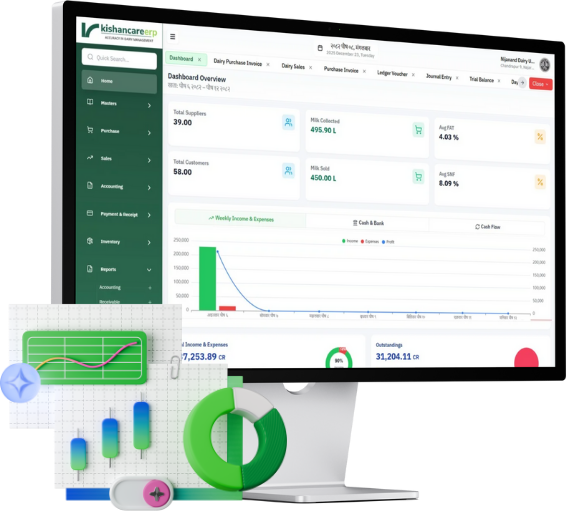
Kishan Care ERP is built around dairy and agro operations in Nepal, including milk collection, fat/SNF rate calculation, farmer and party ledgers, billing, inventory, accounting, reports, role-based access, and multi-branch visibility.
You can review the product modules on the features page, compare business-specific use cases on the solutions page, or browse more operational guides on the blog.
A practical Nepal rollout checklist
Prepare the same comparison scenario for every vendor: one farmer collection entry, one fat/SNF rate calculation, one payment, one sales bill, one inventory movement, and one report.
Start by cleaning master data for farmers, suppliers, customers, products, rates, branches, and opening balances. Then train staff one workflow at a time, beginning with the process that creates the most daily pressure.
For most dairies, the best first phase is collection, payment tracking, billing, or inventory control. Once the team trusts those records, management reporting and compliance review become much easier.
Nepal example
A co-operative comparing software should ask vendors to show how a farmer checks milk sale details, payable balance, and payment notification after collection is approved.
In this kind of setting, ERP does not replace good management discipline. It gives the team a shared record that can be checked by operators, accountants, managers, and owners without waiting for manual summaries.
Conclusion
Kishan Care ERP vs other dairy software Nepal matters because Nepal's dairy operations depend on trust, accuracy, and timely records. When collection, pricing, billing, stock, and payments are easier to verify, the business can reduce disputes and make faster decisions.
The goal is not to add software for the sake of software. The goal is to make daily dairy work easier to control, easier to explain, and easier to grow.
Frequently asked questions
- Why is Kishan Care ERP vs other dairy software Nepal important for Nepali dairies?
It helps dairy teams reduce manual errors, improve record accuracy, and make collection, accounting, billing, inventory, or reporting easier to verify.
- Can small dairy co-operatives use this type of system?
Yes. Small co-operatives can start with one workflow, such as milk collection, farmer ledgers, billing, or stock tracking, and expand after staff are comfortable.
- How does ERP help with farmer and supplier trust?
ERP keeps quantity, rates, deductions, advances, payments, and balances in structured records, making statements easier to explain and disputes easier to resolve.
- Does Kishan Care ERP support Nepal-specific dairy workflows?
Yes. Kishan Care ERP supports dairy workflows such as fat/SNF-based collection, accounting, inventory, billing, reports, branch operations, and payment tracking.
Compare Kishan Care ERP with confidence
Book a demo and test Kishan Care ERP against your real dairy collection, accounting, inventory, Farmer App, and reporting needs.